Do you need compliance yet?
When compliance starts to matter, how the first request arrives, what it pays back, and the handful of ideas everything else hangs on. (About 12 minutes)
If I were a betting person, I’d say you’re probably reading this at midnight. Because your day job is, well, building the product, chasing your first customers, and getting your founding team to do big things.
Compliance? That’s probably not even what you had planned for your second shift. That is, until Bill from your dream top 10 list drops this on call: “you’ve got a SOC 2 report, right?”
Wait, what? Is this something you’re supposed to have already? What does it take to get one? And considering Bill’s willingness to spend, how quickly can you figure this out?
The good news? You’re right on schedule. Almost every founder who sells to the US and beyond hits this moment. Great timing for you and this article—consider this your guide to the compliance galaxy. Now for rule number one: Don’t panic. And if you do, don’t let Bill know.
While compliance can get jargon-heavy and technical, plenty of startups have done it before you. It isn’t an activity reserved for big companies with dedicated legal teams. It follows a fairly predictable checklist, and is a way to show customers, stakeholders, and investors that you can and will protect their data in accordance with applicable laws and security standards.
All it takes is good planning. And you’re in the right place.
Let’s start with when you actually need compliance.
When do you need compliance?
Here’s the short answer: For most startups, compliance only becomes necessary when you start selling. Think of it as something that helps you grow by assuring your customers that their data is safe. But it isn’t something you need to invest in immediately.
Some wise words from Reddit:
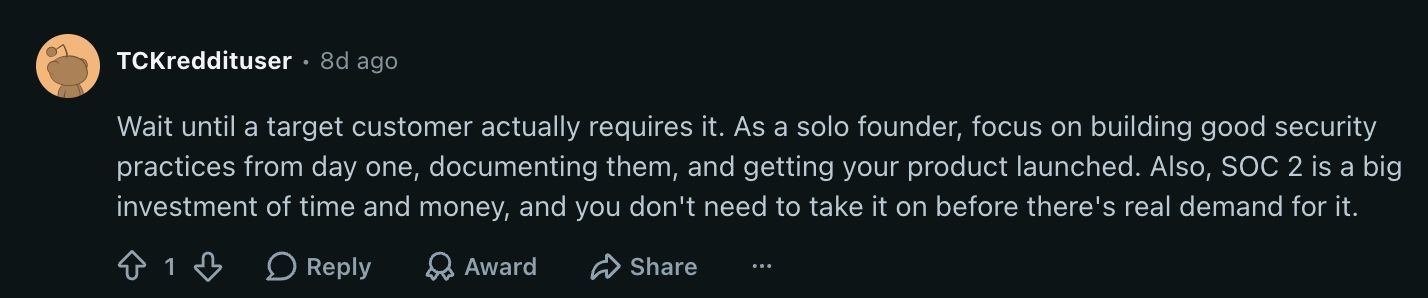
And here’s the long answer: In the early stages of starting up, compliance is at the bottom of your to-do list. Your product is changing on a weekly basis. Your first customers are likely small teams and early adopters who care more about what you’ve built than about your audit reports. And every hour you spend on paperwork is an hour you don’t spend on your product. So at this point, if no one is asking you for compliance, it’s perfectly fine to wait.
But this equation quickly changes as your product grows and as you sell upmarket. Your contracts get bigger, and deals start going through a procurement process rather than a founder handshake. Soon you start encountering compliance in the form of security reviews, questionnaires, and customer requests. And as you build towards mid-market, compliance becomes a standard, non-negotiable clause in customer contracts.
Too early for compliance if you don’t have paying customers or are still cracking product-market fit.
Too early for compliance if you’re only selling to consumers or smaller teams and no one on your customer list has mentioned security yet.
Consider compliance if your customers operate in a highly regulated industry or if you handle sensitive data such as payment card information, financial records, or personal data at scale.
Investors at Series A and beyond mention security and compliance in early conversations.
Accelerators in the US often ask about compliance early because their portfolio companies sell to enterprises.
Start compliance prep before you expect your first mid-market deal to close.
Compliance is non-negotiable at this stage. It shows up in contract discussions, security questionnaires, and sales conversations.
Not having it will likely stall deals.
Managing your first framework request
At its core, compliance starts with three questions:
- How do you protect data?
- How do you prove what you’ve stated?
- Can an independent auditor confirm it?
The tricky part is that every customer could ask these questions in different ways and expect different levels of detail in your answers. This is where a framework comes in.
A framework provides you with a set of guidelines and measures that spell out what good looks like. Complying with a framework involves implementing the appropriate set of controls, gathering evidence of compliance with its requirements, and finally, undergoing an audit. That’s where an independent expert, usually a licensed CPA firm or an accredited certification body, checks your controls and evidence against the framework’s requirements. This allows buyers to compare vendors against the same benchmarks.
A request for compliance may appear in many forms. Here are a few you may encounter:
Most of these requests come with a deadline in mind. You’ll often hear “we’d love to close this quarter.” Sure, this dials up the pressure and starts a silent countdown, but there’s no better reason to prioritize security and compliance. At an early stage, it isn’t an all-or-nothing scenario. Many customers will understand if you show them that you’re committed or present a letter stating that your audits are underway.
The payoff
If you’re feeling a little overwhelmed at this point, congratulations - you’re human!
Most founders find first-time compliance overwhelming. You’ve maybe just moved to a new country, you’re facing a new market, and now a buyer is asking you for something you’ve heard of in passing.
While compliance does sound like another problem to tackle, it pays off immensely when done right. In a recent conversation with Sprinto, Ryo Chiba, the Co-founder of Trails, explained that getting a SOC 2 report led to new inquiries.
But let’s dig a little deeper. Here’s what compliance gets you:
Faster deal closure
No more manual security questionnaires
Investor trust-building
Selling upmarket
Expanding to newer markets gets easier
Building a foundation for security
None of this really means you should rush into an audit, but it is a game-changer for winning bigger deals.
The building blocks of compliance
Compliance sometimes sounds like alphabet soup. While a lot of these terms can be daunting, it gets a lot easier once you learn how each of these terms relates.
In this section, we’ll cover three ideas you’ll keep running into: The key differences between regulations and frameworks, how certifications and attestations differ even though the terms are used interchangeably, and the relationship between controls, checks, and evidence.
Frameworks and regulations decide what you’re held accountable for, and certifications or attestations decide how that gets verified. But regardless of what you choose, the work underneath the hood remains consistent. Everything ties back to controls, checks, and evidence. They form the bedrock of compliance.
Regulations vs frameworks
SOC 2, HIPAA, GDPR, and ISO 27001 are often mentioned in the same breath. And this is where most founders get tangled up - not being able to tell which ones customers simply expect and which ones are mandated by law. Let’s clear this up.
Think of regulations as gravity: they apply whether you like it or not. These are laws that must be followed whether or not a customer asks for them. Breaching these or failing to adhere to them can result in hefty fines. Here are some examples of regulations you may come across in the US:
- HIPAA (applies to you if you handle health information, mandated by federal law)
- State privacy laws such as California’s CCPA (applies to you if you collect consumers’ personal information)
- Europe’s GDPR (applies to you if you’re based in the US but serve customers in Europe)
Frameworks, on the other hand, are more like your mission checklist your customers expect you to follow. They set out security guidelines that help organizations organize their security measures to effectively manage and mitigate cybersecurity risk. Frameworks and standards are completely voluntary—they aren’t laws, and regulators will not fine you for not adhering to them. But they may become a reason your mid-market and enterprise deals stall. Here are the frameworks you may come across:
- SOC 2 (A voluntary attestation created by the AICPA that serves as a default trust signal for software buyers in the US)
- ISO 27001 (A certification created by ISO for organizations handling sensitive information that applies if intending to sell to Europe, Asia, and the UK)
- NIST CSF (A voluntary standard developed by NIST for private organizations and widely expected of federal agencies and government contractors)
Certification vs Attestation
At the end of an audit, you’ll walk away with either a certificate or a report. At first, this might sound like a technicality, but it changes what you get, what your buyers read, and how often you must go through it to maintain compliance.
A certification is a formal stamp of approval. An accredited body assesses you against a fixed security standard and issues you a certificate indicating you adhere to it. The result here is black or white. You either pass the assessment, or you don’t. ISO 27001, for example, is a certification.
A certification is valid for three years but requires yearly surveillance audits to ensure you’re still adhering to the standard.
An attestation is an independent auditor’s written opinion and findings. Instead of a pass or fail, an attestation is a detailed report on what the auditor tested and what they found. SOC 2 is a well-known attestation.
An attestation, on the other hand, is typically valid for a year and must be renewed annually.
Controls, checks, and evidence
If regulations and frameworks set the rules, and certifications and attestations decide how you’re graded, then controls, checks, and evidence are where the groundwork happens. Every framework, no matter how different it looks on paper, runs on the same three components. Let’s break it down.
Controls are rules, policies, and safeguards you have in place to protect data. They cover everything from settings to everyday practices. For example, a control may specify that every company device must have disk encryption enabled and lock after 10 minutes of inactivity.
A check is a repeatable test that confirms whether a control is working as intended. A good check is one that is regular, repeatable, and assesses specific controls.
A device management tool, for example, runs a test to verify that every laptop in your company has disk encryption enabled and auto-lock switched on. This report is then reviewed to enable these settings on devices that do not have them enabled.
Evidence is the proof you hand an auditor. This includes screenshots, system exports, signed and acknowledged policies, and reviews. What the auditor is looking for is a timestamped piece of evidence extracted from the period you’re being audited.
A report detailing the status of disk encryption and auto-lock activation, along with any tickets listing the dates and fixes for flagged devices, would serve as strong evidence. And together, they prove that the control you have in place is functioning as intended.
This brings us to the term audit readiness. You’re audit-ready when your controls are in place, your checks show they're working as intended, and your evidence is collected, dated, and easy to find. And if an auditor decides to turn up tomorrow, you’re able to give them what they need without scrambling to fix gaps or dig out screenshots.
The Exam Analogy
Think of compliance as an exam you’re preparing for. Tap each part of the exam to see what it means in compliance terms.
The framework or regulation is your syllabus. It tells you what you’ll be tested on, but not how you study.
A certification or attestation is what your final grade will look like. A certification gives you a simple pass-or-fail. An attestation gives you a detailed report card.
Controls equate to the study plan you have in place. They’re the commitments you make to cover the syllabus. So a commitment like “practicing a test paper every Sunday” equates to “every laptop is encrypted and auto-locks after 10 minutes of inactivity” in compliance terms.
Checks are your mock exams. They don’t count towards your final result but tell you whether your study plan is actually working. Score badly, and you can go back and fix it before the real thing.
Evidence is the work you show for it—dated exam papers, mock test results, and notes. So if anyone asks you if you’re prepared, you don’t just say “trust me”; you actually show them.
An examiner (the auditor) tests you against the syllabus and looks for proof. And audit-readiness is knowing you’re sufficiently prepared. You’ve covered the syllabus, you’ve passed your mock exams, and you have proof to back it up.